Rental ADU planning · Los Angeles
Rental ADUs in Los Angeles: Test the Project Before Counting the Rent
Evaluate the complete investment, evidence for rent, operating costs, reserves and financing separately. A gross-rent figure cannot tell you whether the project fits your household’s finances.
A rental ADU is worth evaluating when the property can support the proposed unit and the owner can fund construction, operations and uncertain periods without relying on an optimistic rent assumption. Start with a complete project scope and property-specific rental evidence. Then test what remains after vacancy, owner-paid costs, a replacement reserve and debt service.
Keep the decision in stages. A promising monthly illustration does not establish a buildable unit, a loan approval, lawful tenancy terms or an achieved rent. Equally, a well-designed ADU does not prove that its financing works for the owner. Each part needs its own evidence before the combined project becomes a sound commitment.
Explore this guide
Screen the property and the household before modeling income
Define the intended unit: new detached construction, an addition or conversion, approximate room program and expected rental use. Identify the jurisdiction, available property records and major unanswered site questions. A regional ADU label is too broad to determine construction scope or what renters would compare with the finished unit.
Next describe the owner’s objective. Is the goal ongoing cash income, a future family home with interim rental use or another stated purpose? These goals can support different choices about space, privacy and financing. Avoid allowing an assumed rent premium to override the actual reason the household wants a separate dwelling.
The owner’s existing use of the property matters too. Identify parking arrangements, outdoor areas, storage and routes that would change. A rental unit creates another household relationship on the site. Discuss how entrances, deliveries, maintenance and shared spaces would work before treating the remaining yard as an empty building pad.
If the choice between an ADU and expanding the main home remains open, the ADU versus home addition guide addresses that earlier decision. For rental feasibility, the next question is more specific: can this proposed unit, on this property, support a financial arrangement the owner can carry?
Mark unknowns rather than filling them with zero. An unquoted insurance increase is not a zero insurance cost. An unresolved utility scope is not a free connection. A rough first screen may use explicitly hypothetical inputs, but those inputs should remain visible as assumptions requiring confirmation.
Build a comparison set instead of choosing an attractive asking rent
Start with nearby units whose features resemble the proposed ADU. Record bedroom count, advertised size, private entrance, parking, laundry, outdoor space, furnishings, utilities and lease term. Keep the source and date with each observation. Location and unit differences matter; “Los Angeles ADU” is not a sufficiently narrow comparison.
Identify the status of the evidence. An asking listing states what an advertiser is requesting, not what a tenant ultimately agreed to pay. A removed listing does not prove a signed lease. An advertiser’s square-foot description is not a verified permit measurement. These distinctions should remain visible when a number enters the model.
Two advertising examples illustrate the problem. A Califa Street listing in Encino described a one-bedroom, one-bath ADU at 550 square feet and asked $2,400 with water included. A La Salle Avenue listing in South Los Angeles described a one-bedroom, one-bath ADU at 900 square feet and asked $1,680 with listed utilities. These advertiser statements are not achieved rents, verified areas, current-availability assurances or a statistical rental range.
They are also different neighborhoods and units. Averaging them would create a precise-looking number without establishing relevance to the proposed property. The more useful response is to examine comparability: why might the units attract different renters, what is included and what information is missing?
Seek additional property-specific input from an appropriate local rental professional where needed. Keep a professional opinion, advertised evidence and achieved-rent evidence identified separately. Do not silently convert a benchmark or opinion into a guaranteed lease amount.
Refresh the comparison before a consequential decision if time has passed or the proposed unit changes. A different bedroom program, parking arrangement or included utility package may change the comparison. The model should follow the unit being planned, rather than preserving an early income assumption after its basis has disappeared.
Record the full investment and keep funding separate
Build an investment schedule from the project scope. Consider design and professional work, construction, permits and fees, utility work, site restoration, specified equipment and owner costs. Identify inclusions and exclusions so the same item is not counted twice or omitted because everyone assumes another proposal covers it.
Utility questions deserve early attention. The ADU utility connections guide explains the broader sewer, water and power discussion. For feasibility, determine which work and charges are included in the current budget and which remain unconfirmed. Do not assume a connection is inexpensive because a service already exists on the property.
Separate the cost of creating the project from the source of funds. Owner cash and borrowed proceeds can fund the same total investment. They should not be added to construction cost as if the loan itself were another building expense. Loan fees and interest may be separate costs, but loan principal is funding that later produces a repayment obligation.
Identify pre-rental carrying costs and the period they cover. If financing costs during construction are already in the investment schedule, do not add the same months again under holding costs. A clearly defined period is more useful than a large miscellaneous contingency whose contents nobody can explain.
Keep a reserve for uncertainty distinct from money already spent. Its appropriate amount depends on the scope and owner’s circumstances; no universal percentage is supplied here. The important planning question is whether sufficient funds remain available when the project costs more or rental income begins later than assumed.
Review the investment again when the scope becomes more specific. Early feasibility can be provisional, but a commitment should not rely on an old construction figure after utility, site or selection decisions change. Update the owner cash requirement and lender discussion along with the project total.
Separate collections, operating costs and a replacement reserve
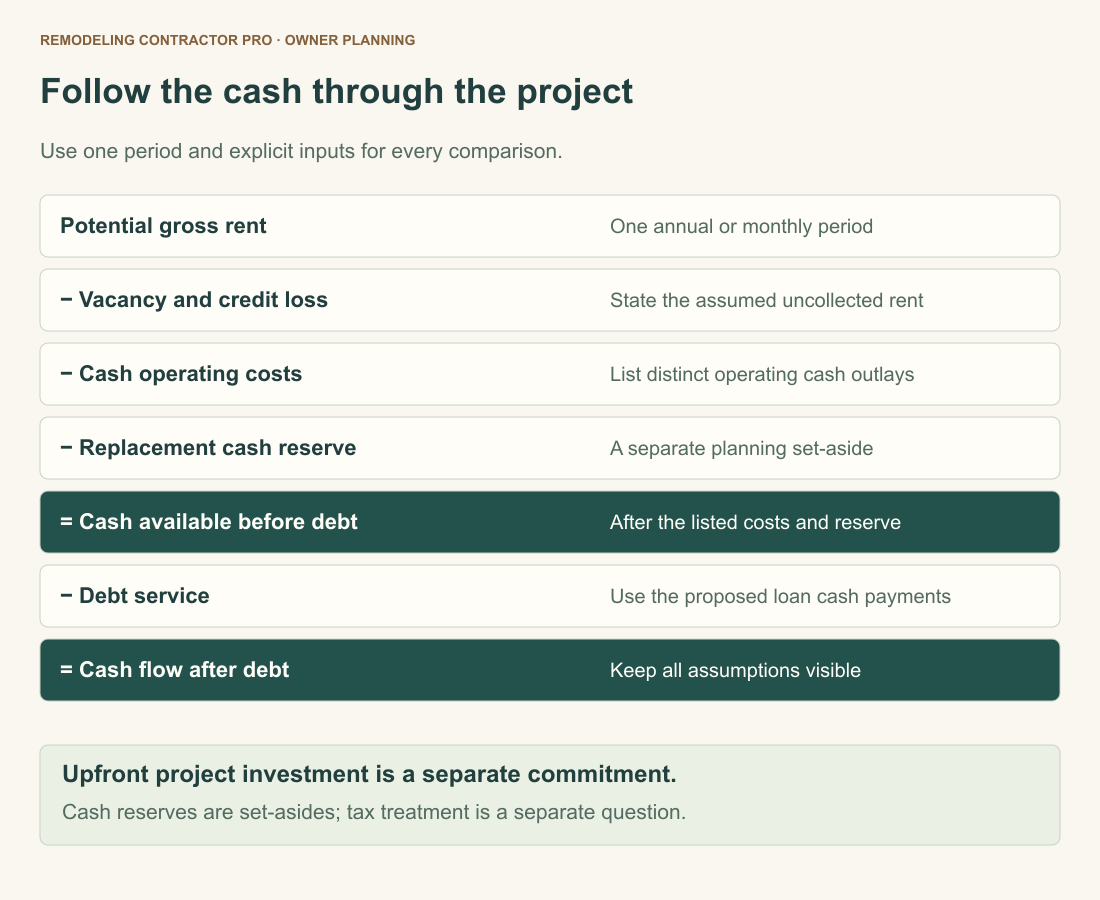
Scheduled rent is the rent expected if all modeled periods are paid in full. Collections can be lower because of vacancy, concessions or unpaid amounts. Choose an explicit assumption for those losses and explain its basis. A round percentage can be useful for a hypothetical sensitivity test, but it is not evidence of local vacancy or an adequate reserve.
List owner-paid cash operating costs separately. Potential categories include utilities, routine maintenance, insurance, incremental property taxes, management and applicable fees. The relevant amount depends on the unit, lease, property and service arrangements. Use actual quotes or informed property-specific estimates where available.
Owner-managed does not mean no management work. Decide who handles leasing, maintenance coordination and tenant questions. If the owner plans to do it, identify that responsibility and consider the effect of needing paid help later. Do not insert a universal management percentage simply to make the model appear complete.
A replacement reserve is cash set aside for future items rather than a current operating invoice. Keep it visible as its own planning line so routine maintenance and future replacement are not accidentally merged or counted twice. The amount should eventually relate to the actual equipment and finish responsibilities.
Then distinguish the cash view from the tax view. The IRS guide to residential rental property treats rental income, expenses, improvements, interest and depreciation under different rules. A reserve contribution, principal repayment and depreciation are not interchangeable. An owner’s cash statement should not be labeled taxable profit.
Use precise labels for intermediate totals. “Cash after operating costs” means something different from cash after reserve funding and debt service. Avoid calling every subtotal profit or using an appraisal term without its defined treatment. A simple statement with clear rows is easier to assess than a single return percentage.
Use lender terms and test the period before rent begins
Obtain terms for the actual financing being considered. Identify fees, construction-period payments, draw conditions, ongoing debt service and any conversion or maturity requirements. The Consumer Financial Protection Bureau’s construction-loan explanation describes advances during construction. Your lender’s written terms determine the actual arrangement.
Do not assume future rent will qualify the owner for a loan or that refinancing will be available on desired terms. Ask the lender how the proposed ADU and any rental income are treated, what evidence is needed and which costs the owner must fund directly. Keep a preliminary conversation distinct from an approval.
Timing matters even when the eventual monthly statement is positive. Construction and leasing do not necessarily produce income on the same date that costs begin. Identify the point at which each payment starts and the conditions that must be met before the unit can lawfully be occupied and rented.
For a delay test, use the owner’s actual cash obligations during the affected period. Lost scheduled rent and a carrying cost can be different quantities. Avoid double counting the same debt payment in both an investment allowance and a later delay line. A period-based cash schedule can expose that overlap.
Keep household reserves separate from the funds committed to construction. Ask whether the household can meet its other obligations while paying project costs and any temporary shortfall. The answer depends on personal circumstances and lender terms, not a universal ADU financing rule.
Confirm rental, tax and insurance assumptions for the property
Start with jurisdiction. City of Los Angeles rules should not be applied automatically to unincorporated County property or an independent city. Then confirm the unit and parcel classification, tenancy circumstances and any relevant replacement history. A new ADU’s age alone does not settle every rental obligation.
Los Angeles Housing Department explains that the City’s Just Cause Eviction Ordinance can apply beyond units covered by the Rent Stabilization Ordinance. Have the actual unit and tenancy reviewed rather than assuming a newly built unit is exempt from all rental protections.
Confirm applicable SCEP inspection and fee obligations and registration or rent-reporting requirements with LAHD. ADU and JADU rental properties may be within the relevant scope, subject to exemptions. Use current property-specific answers instead of a legacy fee amount copied into the model.
Confirm the permitted rental term too. The HCD ADU handbook explains that local agencies may require rental terms longer than 30 days. That is not blanket permission for short-term rental. Check the local rules, permits and applicable recorded restrictions before modeling a particular use.
For property tax, the California Board of Equalization’s new-construction guidance explains that new construction can add assessed market value absent an exclusion, while existing portions are not automatically reassessed by a separate addition. Do not set added assessment equal to construction cost or apply one universal tax percentage. Obtain a property-specific estimate.
Discuss construction and rental use, replacement value and coverage with the insurer using the California Department of Insurance residential guide as a starting point. Then have a tax adviser apply current tax-year facts, particularly if family or personal use is contemplated. Neither a construction proposal nor this cash illustration determines those outcomes.
Read a hypothetical cash-flow statement line by line
The following illustration uses invented assumptions, not a Los Angeles market rent, construction quote, lender offer or investment recommendation. Assume monthly rent of $2,800, a 5% vacancy and collection-loss allowance, $9,000 in annual cash operating costs, a separate $2,400 annual replacement reserve and $18,000 annual debt service.
| Line | Calculation | Annual amount |
|---|---|---|
| Scheduled rent | $2,800 × 12 | $33,600 |
| Vacancy and collection loss | $33,600 × 5% | −$1,680 |
| Modeled collections | $33,600 − $1,680 | $31,920 |
| Cash operating costs | Invented annual assumption | −$9,000 |
| Cash after operating costs | $31,920 − $9,000 | $22,920 |
| Replacement reserve | Separate cash set-aside assumption | −$2,400 |
| Cash available before debt | $22,920 − $2,400 | $20,520 |
| Debt service | Invented annual assumption | −$18,000 |
| Pretax cash after reserve and debt | $20,520 − $18,000 | $2,520 |
The final amount averages $210 a month, but actual receipts and costs would not necessarily arrive evenly. An annual reserve line does not mean a replacement occurs in equal monthly pieces. This illustration excludes appreciation, sale proceeds, income-tax effects, construction delay and pre-rental holding costs.
The $9,000 operating-cost assumption is not a benchmark. A real owner would replace it with itemized inputs for the proposed property and avoid including the separate reserve or debt payment in it again. The example’s positive result depends on every stated assumption; it does not establish a margin appropriate to another household.
Notice what the statement cannot answer. It does not show the total investment, owner cash contribution or how much cash is tied up during construction. Those belong in the investment and funding schedule. It also does not establish taxable income, an appraised operating result or loan qualification.
Change one assumption, then test combinations
First keep the hypothetical rent and all costs unchanged but increase vacancy and collection loss to 10%. Annual collections become $30,240: $33,600 less $3,360. Subtracting $9,000 operating costs, the $2,400 reserve and $18,000 debt service leaves $840 a year, or $70 a month on average. Neither 5% nor 10% is presented as normal local vacancy.
This single change reduces annual cash by $1,680. It shows how a modest-looking positive result can depend on collections. The appropriate response is to improve the evidence and assess reserve tolerance, rather than assume the higher-loss case cannot happen.
Next test a lower rent using a clearly stated alternative input. Separately test higher owner costs, a larger investment and a later start to rent. Keeping changes separate initially shows what drives the result. After that, combine plausible adverse assumptions to examine the household’s ability to carry the project.
A construction overrun affects the funding need even if the eventual rent remains unchanged. It may require more owner cash or different financing, which can also change debt service. Do not assume the overrun can be resolved by increasing rent; the rental evidence does not automatically change because construction costs do.
Likewise, a lease-up delay concerns the initial period, while recurring vacancy concerns ongoing collections. Define the modeled periods so one loss is not counted twice. If the owner is unsure which costs overlap, reconcile the cash schedule with the lender or adviser before relying on a single total.

Replace broad expense guesses with useful evidence
An expense total is only as informative as its contents. Break it into items and identify the source of each one. An insurance quote for the proposed rental use has a different status from an unchanged homeowners premium. A property-tax planning answer has a different status from multiplying construction cost by a remembered percentage.
| Input | Useful evidence | Question to resolve |
|---|---|---|
| Owner utilities | Proposed service and lease arrangement | Which consumption or charges remain with the owner? |
| Insurance | Insurer’s property-specific response | Does it address construction and planned rental use? |
| Property tax | Assessment guidance for the actual addition | What incremental amount should be planned? |
| Maintenance | Actual systems and service responsibilities | What is routine and what belongs in replacement planning? |
| Management | Owner commitment or quoted service scope | Who handles leasing, calls and turnover? |
| Local obligations | Confirmed unit and parcel classification | Which fees or required services apply? |
Use the same included-services assumption on both sides of the statement. If comparable asking rents include utilities, but the proposed lease would charge them separately, do not treat the listings as equivalent without examining that difference. Likewise, if the owner includes a service to support the proposed rent, include the corresponding cost where the owner bears it.
Make replacement planning specific enough to understand without claiming an exact future date. List the equipment and finishes for which the owner expects responsibility. A reserve is a planning choice that needs review as the unit and operating arrangement become defined; it is not a guarantee that every future expense is funded.
Distinguish the owner’s cash commitment from the building total
Here is a separate hypothetical funding illustration. Assume a total upfront project investment of $300,000, funded with $120,000 of owner cash and $180,000 of borrowed proceeds. The two funding sources add to $300,000. These invented numbers are not an ADU price range, financing offer or indication of required equity.
The $180,000 loan is not added to the $300,000 as another construction expense. It is a source of funds, while repayment creates future cash obligations under the actual loan terms. The owner must understand fees and interest separately and obtain the ongoing payment from the lender rather than infer it from the borrowed principal alone.
Now assume an additional hypothetical $20,000 project overrun, funded entirely by owner cash without changing the loan. Total investment becomes $320,000, and owner cash becomes $140,000. The loan remains $180,000. The overrun increases cash tied up in the project even though no change to monthly debt service has been assumed.
This distinction matters when reviewing an apparently positive rental statement. The earlier $2,520 annual cash illustration does not explain whether the household can commit $120,000, $140,000 or any other cash amount. Monthly operating feasibility and upfront funding capacity answer different questions. Both need to fit before the owner relies on a combined conclusion.
Do not combine these examples into a promised return. They use independently invented inputs to explain categories. A real assessment needs a consistent project budget, actual funding terms and supported rental assumptions, with the timing of each cash movement made clear.
Model the initial rental period separately from a steady year
The annual cash statement assumes a full modeled operating year. The first period may include time before the unit is ready or before a tenant begins paying. Identify those periods on a calendar and assign the costs that actually continue during them. Do not apply a steady annual result to a partial opening year without adjustment.
For a small hypothetical delay example, assume two months of additional pre-rental carrying costs at $1,600 per month. The added cash requirement is $3,200. That figure represents only the stated carrying costs; it is not an estimate of lost profit, construction delay or a complete first-year cash result.
Before adding the $3,200 to another total, check whether those same months and costs are already included in the upfront investment or another holding-cost allowance. Similarly, do not count a month as both an explicit lease-up delay and a second loss inside an overlapping vacancy allowance. Define which period each assumption covers.
The practical question is how much cash the household needs before the unit contributes income. A positive steady-year illustration cannot pay an earlier bill. The owner should know the source of funds for that initial period and what happens if it extends beyond the first assumption. Identify any household commitments that compete for the same reserve before treating the money as available to the rental project.
Set a personal decision threshold without inventing a return target
Decide what the household can tolerate before choosing the most favorable scenario. Identify cash that must remain available, a monthly shortfall the household can carry and assumptions that require confirmation before commitment. These are owner decisions, not universal investment thresholds.
If the project works only with the highest advertised rent, no meaningful vacancy and unquoted owner costs, the next step is evidence repair. If it remains manageable under less favorable assumptions, that is useful information, but it still does not guarantee occupancy or future income.
A simple gross-rent yield or gross-payback calculation leaves out costs and timing. A cash-on-cash comparison uses a different denominator from a return on total investment. Rather than choosing whichever percentage looks best, state the definition and include the relevant cash requirements. This article does not prescribe a payback date or assume future appreciation.
The decision may be to proceed with more detailed feasibility, change the unit program, alter the financing approach or defer the project. Tie that decision to the unresolved input that matters most. For one owner it may be utility scope; for another, tenancy classification, lender terms or evidence for achievable rent.
Use the worksheet as an assumptions brief
The Rental ADU financial screening worksheet has 20 editable notes fields for the property, rent evidence, costs, debt, investment, delay and downside assumptions. It creates a notes summary, clears entries and supports browser printing. It does not autosave, submit information, calculate cash flow, predict rent or qualify a loan.
Use the worked arithmetic above as a transparent illustration, then keep your own amounts and sources separate. Mark blank information as unknown rather than silently treating it as zero. Print the notes before leaving the page if you want to retain them for a lender, adviser or project conversation.
Bring the proposed unit, available property information, current cost scope, rental evidence and unresolved questions together. The next useful result is a property-specific feasibility direction whose limits are understood, with the household’s cash commitments as visible as the possible rent.
Discuss the construction side of a rental ADU with Remodeling Contractor Pro. Share the property address, intended unit, available plans and proposed budget so the scope conversation can address the assumptions that matter.
REMODELING CONTRACTOR PRO · OWNER PLANNING
Rental ADU financial screening worksheet
Use this worksheet to record the actual property, proposed work and questions you need to resolve. Keep the source of an answer, who is responsible and the next action beside your notes. Leave an unknown item visibly unresolved.
Create a separate saved copy for each option, concept or service you are comparing. This tool does not submit your entries or save them automatically. Use View entered notes to select and copy a summary, or Print / save as PDF through your browser before closing or reloading. It does not calculate costs or determine approvals.
Your entered notes