

Hiring a general contractor in the Los Angeles area
Remodel Project Supervision: Agree on Who Decides and Who Reports
Before signing a substantial remodel contract, agree who runs the work, who can authorize decisions, how questions are recorded and who covers an absence. A named project manager is a starting point. The useful test is whether an ordinary problem can reach the right person, receive a documented answer and return to the people doing the work.

Explore this guide
Ask how this particular project will operate
Imagine that a cabinet drawing conflicts with a wall measurement. The installer needs an answer, the homeowner is at work and the person who sold the project is unavailable. Who logs the issue? Who confirms the measurement? Who asks the designer for input? Who may approve a change? Who tells the installer which drawing to use? These are different responsibilities, even when one person fills several roles.
Ask the prospective contractor to walk through that event using the proposed team for your project. Record names where they are confirmed and job roles where appointments are still pending. A general statement that the company communicates well does not answer the operating question. You need to know how its proposed arrangement connects a field observation to an authorized, usable decision.
Separate routine information from decisions. A photograph of framing progress is an update. A request to choose between two cabinet dimensions needs an identified approver and supporting information. A discovered condition may need professional investigation before anyone can offer a choice. Treating all three as ordinary chat messages makes it difficult to see what is waiting, who owns it and what later work depends on it.
This guide provides a way to compare proposed arrangements. The tables, weekly rhythm and response examples are planning tools to discuss with a contractor, not a description of Remodeling Contractor Pro’s staffing or a promise that every project uses the same process. The final arrangement should reflect the actual agreement, the scope and the people assigned.
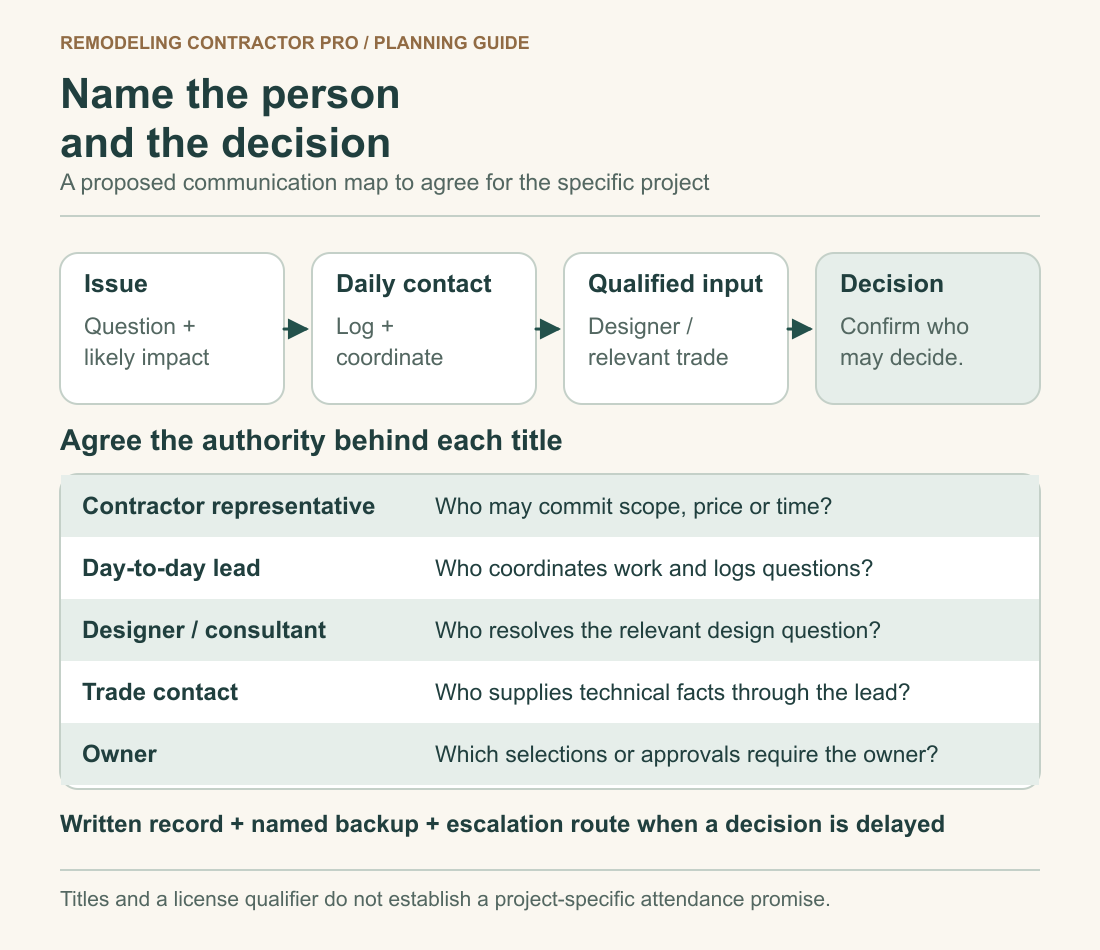
Build a role and authority table
Use a role table before accepting a contact list. A telephone number tells you where a message might go; it does not tell you what that person may decide. Ask each participant’s normal responsibility, authority limit, recordkeeping duty and backup. If the same person is principal, project manager and site lead, record those functions separately so an absence does not erase several responsibilities at once.
| Role | Operating question | Authority to establish | Backup and record |
|---|---|---|---|
| Contractor principal or contracting representative | Who represents the contracting company when an issue cannot be resolved by the project team? | Who may commit the company within the agreement, including a scope, price or time decision? | Identify an authorized replacement and how the commitment is documented. |
| Qualifying individual for the license | How are the licensee’s supervision and control responsibilities carried out? | Distinguish the legal role from the project’s daily communication assignments. | Ask how the operating team reaches appropriate supervisory help. |
| Project manager | Who coordinates information, schedule questions, selections and trade interfaces? | Which matters can this person decide, and which require another approval? | Name coverage for planned leave and a record location accessible to the replacement. |
| Site lead or superintendent | Who handles the day-to-day work coordination and reports field questions? | Clarify the limits of field authority; do not assume this role can approve contractual changes. | Identify the person covering site coordination and communicating the handoff. |
| Trade contractors | Who supplies trade-specific findings and coordinates them with adjacent work? | Keep professional and installation responsibilities with the appropriate qualified people. | Establish the route for questions and updated information through the contractor. |
| Designer and other design professionals | Who interprets or revises the relevant design information? | Confirm which decisions require design input, and who issues the revised document. | Record the professional contact and the process during an absence. |
| Homeowner and designated owner representative | Who supplies household priorities, selections and authorized owner decisions? | Establish whether one owner can decide for the household and the limits of any representative. | Name a backup or an agreed hold/escalation route when a decision cannot be made. |
Ask for an example of an issue the project manager would escalate. A useful answer names the boundary: perhaps a design interpretation, an unpriced request or a condition outside the agreed work. “The manager handles everything” leaves that boundary invisible. The purpose is not to create layers for their own sake; it is to make sure a person receiving a question knows whether to answer, coordinate input or seek authorization.
Also distinguish the salesperson from the operating team. A salesperson may remain involved, but that cannot be assumed. Before signing, ask how promises from the proposal discussion will be transferred into the actual project documents and assignments. If a reporting arrangement matters to your decision, have the contractor confirm it in the applicable written agreement rather than relying on the memory of a sales conversation.
For the homeowner, define a decision route that the household can follow. If several owners send different instructions, the project team needs a way to identify the authorized answer. Agree who consolidates selections and how unresolved differences are handled. This is an administrative arrangement; it should not turn the homeowner into the person directing trade methods or deciding technical suitability.
Understand what California’s supervision rules do and do not answer
Business and Professions Code section 7068.1 assigns the qualifying individual responsibility for supervision and control of the licensee’s construction operations to secure compliance. The current text is available in the CSLB’s 2026 contractor law reference. This is a legal responsibility associated with the license, not a complete project communication plan.
The same section describes supervision and control in terms that include direct supervision or monitoring, with availability to assist people to whom work is delegated. It does not establish a universal promise that the company owner or qualifier personally attends every job every day. Ask how the proposed company arrangement fulfills its responsibilities, and separately ask what attendance and contact arrangements apply to your remodel.
A qualifier’s name therefore does not tell you who will answer a cabinet question on Tuesday morning. Nor does a project manager’s title establish who holds the statutory role. Keep those questions separate in your record. If the proposal uses “owner supervised,” “managed daily” or similar language, ask what the phrase means for this project and where that commitment is recorded.
CSLB identifies the subcontractor-related amendments made by SB 517 as effective January 1, 2026. Use the current statute rather than older summaries of proposed bill language. In particular, the final disclosure structure should not be replaced with an old claim that only subcontractors performing more than half the work need to be disclosed.
Under current section 7159(c)(7), the applicable home-improvement contract includes a statement about subcontractor use and, where subcontractors will be used, specified notice about the list available on request. The provision addresses requested names, contact information, license numbers and classifications. Read the current statutory language for its scope. As a project-planning step, ask how the contractor will identify the trades and route their questions.
The provision also requires the subcontractor disclaimer on each change order. That legal requirement is distinct from the operating question of who coordinates a proposed change. A weekly log can point to the relevant contractual document, but it should not be treated as automatically replacing the approval process required by the actual agreement and applicable law.
Section 7159(a)(5)(B) addresses the prime or direct contractor’s responsibility for completion in accordance with the home-improvement contract, plans and specifications for purposes of administrative discipline. It expressly preserves discipline of others. Do not turn that rule into a broad claim that subcontractors have no responsibility or a prediction of legal recovery. The practical task is to establish a clear contractor-led route for coordination and reporting.
Make the decision record useful to the next person
Every material open question needs a concise description, its location, a named person responsible for moving it forward and the evidence required for an answer. A photograph can show what prompted the question, while a marked drawing can identify the affected location and revision. Include both when they help; avoid a large unorganized attachment bundle that makes the actual request difficult to find.
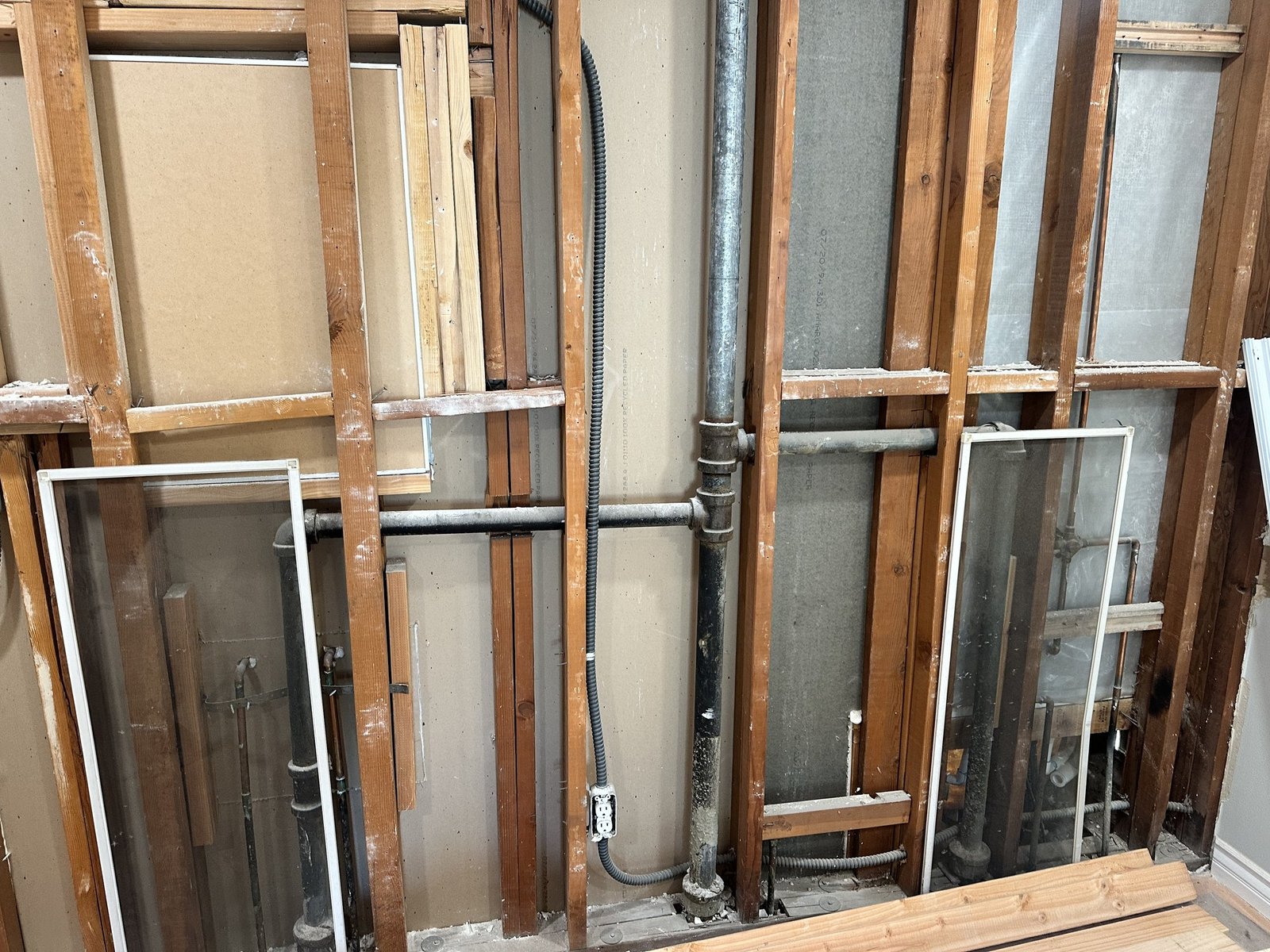
Give the record separate fields for “response needed” and “authorization needed.” A plumber might need to explain a route question before the designer can revise a layout. The owner may later choose among developed alternatives. A message that jumps straight to “please approve” hides the missing professional work. Record the next action at its real stage, even when that action is to obtain information.
State a requested response time and its basis. “Needed before the cabinet order is released” explains a dependency. “Please answer immediately” does not tell the recipient what is at risk. Ask the team to confirm a realistic date and what happens if the answer is unavailable. An agreed response arrangement should distinguish acknowledging a message from supplying a fully supported decision.
The written project description and significant-material information required by applicable section 7159 contracts provide an important reference for these discussions. Section 7159(d)(7) does not prescribe a universal weekly reporting cadence. A recurring update is a proposed practice that helps participants connect decisions to the agreed scope; it is not a substitute for the contract, plans or properly handled revisions.
When an issue is resolved, record the answer, the authorized person, the supporting document and who received it. “Done” is insufficient if the field team still has the old drawing. Closing the communication loop includes identifying the version now in use and making the superseded information recognizable. Ask how the contractor’s actual system handles that distribution rather than assuming any particular app or project portal.
A worked example of a weekly update and decision log
The following is a fictional example for the week of June 8–12, 2026. Its dates and response expectations are invented to show the relationships among information, authority and follow-up. They are not legal deadlines, a construction schedule or an RCP service commitment. A real team would agree its own cadence and adjust requests to the actual work and professional availability.
| Issue and evidence | Next action and responsible role | Decision authority | Example due date and response expectation | Absence coverage and next impact |
|---|---|---|---|---|
| D-01: cabinet elevation and field measurement differ; marked drawing C2 and measurement record attached. | Project manager obtains designer review and confirms which dimension is unresolved. | Designer supplies the design revision; designated contractor and owner representatives handle any resulting commitment under the agreement. | Input requested June 9; acknowledge June 8 and confirm whether a supported answer is available by the requested date. | Backup manager tracks the request if the assigned manager is away. Do not release the affected selection on an unanswered assumption. |
| D-02: owner has not chosen between two reviewed finish samples; both identified in the selection list. | Owner compares the physical samples against the agreed selection information. | Named owner approver makes the selection; contractor confirms any associated scope effect separately. | Selection requested June 10; owner reports June 9 if the household cannot decide in time. | Owner backup may decide only within agreed authority; otherwise manager records the unresolved dependency. |
| D-03: trade raises a ventilation-route question; location photograph and plan reference supplied. | Site lead logs the question; manager coordinates appropriate trade and design input. | Qualified people resolve technical suitability; contractual decisions follow the actual agreement. | Investigation update June 11; do not describe this as a promised final solution date. | Site backup knows which affected activity needs direction. Manager identifies the work dependency without inventing an answer. |
| D-04: manager will be away June 12; two decisions remain open. | Manager sends the current log, document versions and contact coverage before departure. | Principal confirms the replacement’s actual authority and escalation route. | Coverage acknowledged June 11; recipients confirm where to send questions June 12. | Backup receives the same records and reports unresolved matters at the next agreed update. |
A weekly narrative can then stay short: completed work is supported by identified records; the next activities are described as the current plan; decisions D-01 through D-03 remain open at their stated stages; absence coverage is recorded in D-04. The useful detail lives in the log. A long email repeating every conversation is harder to maintain and can obscure the items actually awaiting action.
Do not mark D-01 approved merely because the owner says the proposed cabinet looks good. The designer’s input, scope consequences and authorized commitment are separate pieces of the record. Likewise, D-03 should not be marked complete because someone acknowledged the photograph. The example deliberately separates the date for an investigation update from the date when a supported solution can be confirmed.
At the next meeting, review changed status rather than reading every closed entry aloud. Confirm who received the new information and whether another item depends on it. If a requested date was missed, record the new next action and escalation. This keeps the update honest about what is known and prevents a hopeful schedule from becoming an unsupported promise.
Agree on response expectations and absence coverage
Discuss normal contact hours, preferred communication channels and what kind of question belongs in each. Routine selections may suit the agreed written record; a time-sensitive site issue may require another contact route. Ask the contractor to define that route and its limitations. A general messaging channel should not be assumed to provide continuous monitoring or emergency response.
For planned leave, request a handoff that identifies the open questions, current drawings, expected decisions and the replacement’s authority. A backup name without access to the documents may still leave the project waiting. Ask the replacement to acknowledge the handoff, and tell the owner and relevant project participants which contact applies during the absence.
Consider the homeowner’s absences as well. If you will be traveling, identify which selections can be completed beforehand and which need a designated representative. Record what the representative may approve and what must wait for you. Do not assume that silence means consent or that a person collecting messages can authorize a change in scope, price or time.
Agree how to handle an unanswered decision without pressuring someone into an uninformed approval. The team may need additional investigation, another qualified opinion or a revised sequence. Ask the contractor to explain the actual consequence and available next steps. The owner should not be asked to direct unsafe work or improvise a technical solution simply because an expected answer is late.
Workmanship concerns need a reporting path too. Describe the location and observed condition, attach useful evidence and ask who will assess it. Avoid immediately instructing a trade to remove or redo work outside the established coordination route. Document the response and any follow-up, while preserving the appropriate response to an immediate hazard through the responsible site personnel and applicable emergency services.
Test the arrangement before accepting a promise
Run three ordinary scenarios during the proposal discussion: a selection conflicts with a measured condition, the assigned manager is away and the owner questions completed work. Ask the prospective team to identify the first contact, required evidence, authority boundary and written outcome for each. Consistency across those answers is more useful than a promise to “handle everything.”
If an answer relies on a person who has not been assigned, ask when that appointment will be confirmed and how the commitment will appear in the project record. If responsibilities are split between a designer retained by the owner and a contractor, clarify who requests input and distributes revisions. Coordination can be assigned without pretending that one participant controls every professional’s judgment or availability.
Do not substitute inspection milestones for operating supervision. LADBS’s inspection guidance describes City review of specified construction stages and documentation. Those agency activities have a different role from day-to-day coordination and do not guarantee that every defect or unanswered household question will be found. For unincorporated County properties or independent cities, confirm the appropriate authority rather than importing the City’s process.
Check whether reporting promises have a clear meaning. “Weekly update” could mean a photograph, a meeting or a written account with open decisions. Ask what will be included, who prepares it and how participants identify an unanswered item. The same applies to “site supervision”: establish the proposed coverage and responsibilities rather than assuming a title implies uninterrupted physical presence.
A useful agreement can be simple. It needs an accessible record, named responsibilities, a workable response route and a way to identify an authorized decision. Adding software does not cure missing authority, and adding meetings does not cure missing information. Choose an arrangement the actual team can maintain and the household can use consistently.
Use a sample meeting to expose missing responsibilities
Try the fictional log in a short review before adopting it. The site lead reports that the cabinet measurement in D-01 has been confirmed. Ask the manager what changes in the record. A useful response identifies the measured dimension and source, sends that information to the designer and leaves the design question open. A poor response closes the item because the field measurement is complete, although nobody has reconciled the drawing.
Next, suppose the designer returns a revised elevation but the owner approver is away. The backup can acknowledge receipt without approving a decision outside the authority granted. The manager records what is waiting and explains the downstream dependency. This is where absence coverage becomes concrete: the team knows whether another authorized person can act, whether more information can be gathered or whether an affected decision must remain unresolved.
Then introduce a conflicting instruction. One homeowner tells a trade to retain the original cabinet while another sends the manager a new selection. Ask the proposed contractor how it would reconcile the discrepancy before treating either message as direction. The operating plan should identify the authorized owner contact and the record that communicates the settled answer, rather than relying on whichever instruction arrived last.
Finally, revisit the completed item one week later. Can the replacement manager find the current drawing and understand why it changed? Can the installer distinguish the approved version from the earlier image? Can the owner identify any associated contractual document? If the answer depends on a private text thread unavailable to the replacement, the record needs a clearer distribution or access arrangement.
This exercise does not require a complex dashboard. A well-maintained table and identified attachments may be enough for the proposed scope. What matters is that evidence, professional input, owner decisions and contractual commitments remain distinguishable. Ask the team which record it actually intends to maintain and how you will know when an item requires your attention.
Also agree which matters belong outside the ordinary meeting. A scheduled update should not cause someone to hold an urgent site concern until the end of the week. Request the responsible contact and escalation route for that situation, with the contractor’s actual limitations made clear. The weekly record can later preserve the outcome without becoming the only way to reach the people responsible for the work.
Keep the operating record connected to the project documents
At the start, identify the contract and plan versions the team will use. Establish where selections, approved revisions and relevant correspondence are kept, and who may update each record. A homeowner should be able to see the current answer without searching through several contradictory message threads. Ask what access remains available when a contact changes.
Use stable issue labels rather than relying only on a meeting date or photograph filename. A cabinet question may pass through measurement, design review, owner choice and scope documentation. One label lets everyone follow that history. It also makes a weekly update concise: the writer can report the changed status instead of reconstructing the whole discussion.
For broader decisions before demolition, use the separate whole-home renovation planning guide. Here, keep the focus on how the chosen work will be coordinated. This operating plan supports the project documents; it does not replace the contract, the professional design responsibilities or the contractor’s responsibility for its work.
Remodel supervision and decisions record
Open the remodel supervision and decisions record to document the contracting representative, daily lead, backup, trade and designer routes, approval authority, meeting arrangement and unanswered responsibilities. Its 20 fields are an original planning aid consistent with the emphasis on written specificity in CSLB’s consumer contract guidance. They do not establish anyone’s authority by themselves.
The worksheet creates a notes summary, can clear the entries and supports browser printing. It does not autosave, calculate, send a message or submit an approval. Retain your own copy before closing it, then ask the proposed project team to confirm the arrangements that matter in the appropriate written documents.
Sources and further reading
REMODELING CONTRACTOR PRO · OWNER PLANNING
Remodel supervision and decisions record
Record the actual property, proposed work and the decisions you need to resolve. Keep the source of an answer, the responsible person and the next action beside your notes. Leave an unknown item visibly unresolved.
This worksheet does not submit or save entries automatically. Use View entered notes to select and copy a summary, or Print / save as PDF through your browser before closing or reloading. It does not calculate costs, design construction or determine approvals. Keep a separate saved copy for each option you compare.
Your entered notes