Construction agreements · California
California Contractor Payment Schedules: Connect Each Payment to a Clear Scope
Identify the agreement’s rules, then connect each request to the scope, completed value and supporting documents. A readable schedule gives both parties something concrete to review.
A useful contractor payment schedule explains what each payment covers and how the parties will review it. Before accepting a deposit amount or a sequence of percentages, establish the type of contract and the rules that apply. California home-improvement protections cover ADU work, while qualifying new-main-residence agreements and certain other contracts need their own scope review.
Next read the schedule beside the actual scope. “At midpoint” or “when materials are ordered” can leave an owner unsure what has been earned, delivered or previously paid. Clear descriptions and an agreed review process make the payment conversation more specific. They do not turn an example schedule into a legally sufficient contract for every project.
Explore this guide
Check the contract type before applying a payment rule
Start with the work and transaction, rather than the heading printed on a proposal. Remodeling an existing home, constructing an ADU, building a new main residence and performing a special service or repair agreement are not interchangeable contract categories. If classification is uncertain, resolve it with CSLB or qualified California construction counsel before relying on a payment exception.
The CSLB advisory on ADU payments expressly applies home-improvement payment guidance to ADU construction. A new detached ADU does not become an unrestricted new-main-house contract merely because its building is new. That distinction matters when someone requests a large amount before work or deliveries.
Another important boundary concerns rebuilding. Business and Professions Code section 7151 includes qualifying declared-disaster residential rebuilding within home improvement. Section 7164 separately addresses construction of a single-family dwelling to be retained by the owner for at least one year. Both appear in the CSLB’s 2026 license law book. Do not assume every replacement house loses home-improvement protections.
Ask the proposed contractor to identify the agreement category and basis for any claimed exception. Keep the answer with the proposal you are actually considering. A broad statement such as “new construction always requires a larger deposit” does not address ADU scope, disaster rebuilding or the particular contract.
Also distinguish a separate professional-service agreement from a contractor’s construction agreement. A design payment or lender charge should not be casually relabeled as a construction deposit. Have overlapping agreements reviewed together so responsibilities, amounts and deliverables are clear. A worksheet can organize those questions, but cannot make the legal classification for you.
Separate the downpayment from earned progress payments
Under the ordinary California home-improvement rule, the downpayment is limited to the lesser of $1,000 or 10% of the contract amount. CSLB explains the rule in its home-improvement contract guidance. The limit is not a recommended deposit and does not mean every contractor must charge the maximum.
Two hypothetical calculations show why “10% deposit” is incomplete. For an $8,000 contract, 10% is $800, which is less than $1,000. For a $40,000 contract, 10% is $4,000, so the ordinary limit is $1,000. These arithmetic illustrations assume no qualifying exception and exclude separate finance charges. They are not construction quotes or licensing-exemption examples.
A statutory exception exists for qualifying full-performance-and-payment bonding or Registrar-approved equivalents or joint control. An ordinary license bond or insurance policy does not establish that exception. Verify the exact arrangement with CSLB under section 7159.5(a)(8), rather than relying on the word “bonded.” The CSLB contractor-selection guidance also explains why bond and insurance information need specific review.
For an ordinary covered home-improvement arrangement, progress payments must not exceed the value of work performed or materials delivered, apart from the permitted downpayment. The CSLB ADU payment warning addresses this directly. A material order, calendar date or lender draw does not by itself establish that value.
Final payment is another distinct event. Read the agreed completion and closeout terms rather than assuming the final invoice means all questions have been answered. What completion evidence is contemplated? Which listed deliverables remain? Resolve those definitions before the end of the work, when it is easier to distinguish an agreed obligation from a new expectation.
Keep the labels accurate throughout the agreement. Dividing a large advance into a “reservation,” “mobilization” and “materials commitment” does not by itself explain its legal treatment. Ask what the money pays for, when that value is provided and what basis applies to an advance. If the response depends on an exception, have the exception verified before proceeding.
Read the schedule beside drawings and specifications
A dollar amount becomes understandable when its work boundary is clear. Identify the drawing revision, specification or scope section associated with the milestone. “Framing complete” may leave questions about which area, which related work and which exclusions are included. The schedule should be read as part of the agreement, not as a separate marketing summary.
For normal covered home-improvement contracts, section 7159.5 requires a schedule in dollars and cents that references work or services and materials or equipment. See the official CSLB law compilation. A percentage beside an undefined phase does not demonstrate that its value is appropriate.
As a practical review method, connect each request to four questions: what scope is included, what is complete or delivered, what was previously billed and what evidence is available. A photo may show that an activity happened while leaving quantities or concealed details unresolved. An invoice may identify an item without proving delivery. Choose evidence that answers the actual question.
Distinguish a milestone amount from the remaining project balance. A schedule that totals correctly can still be poorly matched to progress. Conversely, an earned amount may need clarification even if it fits a scheduled percentage. Arithmetic and completed value are different checks, and both deserve attention.
Do not make a permit inspection carry more meaning than it has. An inspection record can be relevant to a defined scope, but it is not a substitute for every contract requirement, delivery record or payment document. If the agreement uses an inspection-related milestone, describe precisely what record the parties intend to review.
For a substantial renovation, align payment planning with the decisions made before work begins. The whole-home renovation planning guide addresses the larger scope discussion. Unresolved selections and exclusions become payment questions when they remain vague in the agreement.
Clarify materials, delivery and storage before a request arrives
Materials are often where payment descriptions become least precise. Separate an item being selected, ordered, manufactured, shipped, delivered and installed. Those are different events. If a schedule mentions materials, identify which event it means and what supporting record will be available.
A special-order item does not by itself create an exception to the ordinary home-improvement downpayment limit. CSLB’s contract guidance makes this point. A supplier’s commercial terms do not automatically establish what the contractor may collect from the homeowner.
For a request involving delivery, seek a description that identifies the specified item, quantity and delivery location. Compare model numbers or approved selections with the agreement. If a substituted product is proposed, resolve that scope question rather than treating any similarly named item as equivalent.
Stored materials introduce additional questions: where are they, who controls access, how are they identified for this project and who is responsible for damage or loss? Off-site storage can raise legal and insurance issues beyond an ordinary receipt. Have those arrangements reviewed for the actual agreement rather than assuming a supplier invoice proves acceptable delivered value.
Owner purchases need a clear boundary too. If you purchase an appliance directly, identify who receives, stores and installs it, who checks dimensions and what happens if it arrives damaged or late. Keep that payment separate from a contractor request for the same item so the cost does not silently appear twice.
Discuss these issues while selections are being made. A useful answer identifies the item and responsibility. “Materials are expensive” describes a business concern but does not resolve the payment basis. Clear arrangements help both parties plan procurement without leaving the owner to infer what a general materials line represents.
Keep allowances and changes visible in the payment balance
An allowance leaves a selection or amount to be reconciled under the agreement. Before signing, identify what it includes: product only, related installation, delivery, tax or another defined component. Otherwise, the owner may compare a showroom price with an allowance covering a different set of costs.
Once a selection changes the scope or price, connect that decision to a written change order. CSLB’s home-improvement contract guidance calls for signed change orders before changed work. Discuss the effect on price and payment scheduling while the choice is being made, rather than reconstructing it from a later invoice.
Consider a hypothetical fixture change. The owner selects a different sink, but the replacement also needs a different cabinet arrangement and installation detail. The meaningful comparison includes the entire affected scope. Treating only the product-price difference as the change can leave labor and related work unresolved.
Keep approved and unresolved changes distinct. A selection conversation is not the same record as an agreed price adjustment. If the parties have not resolved the amount or scope, identify the open question and the person responsible for answering it before the changed work proceeds.
Update the running balance consistently: original contract amount, approved additions and credits, current contract amount and payments already made. Keep the payment request separate from the full value of a change so the same adjustment is not counted once in the revised contract and again as an unrelated extra.
Credits deserve the same clarity as additions. If an item is omitted, identify whether associated installation or other work also changes. A broad “credit later” note can make the final balance difficult to reconcile. Ask for an understandable adjustment tied to the omitted scope, without assuming every component has the same treatment.
Keep payment evidence and lien releases in the right order
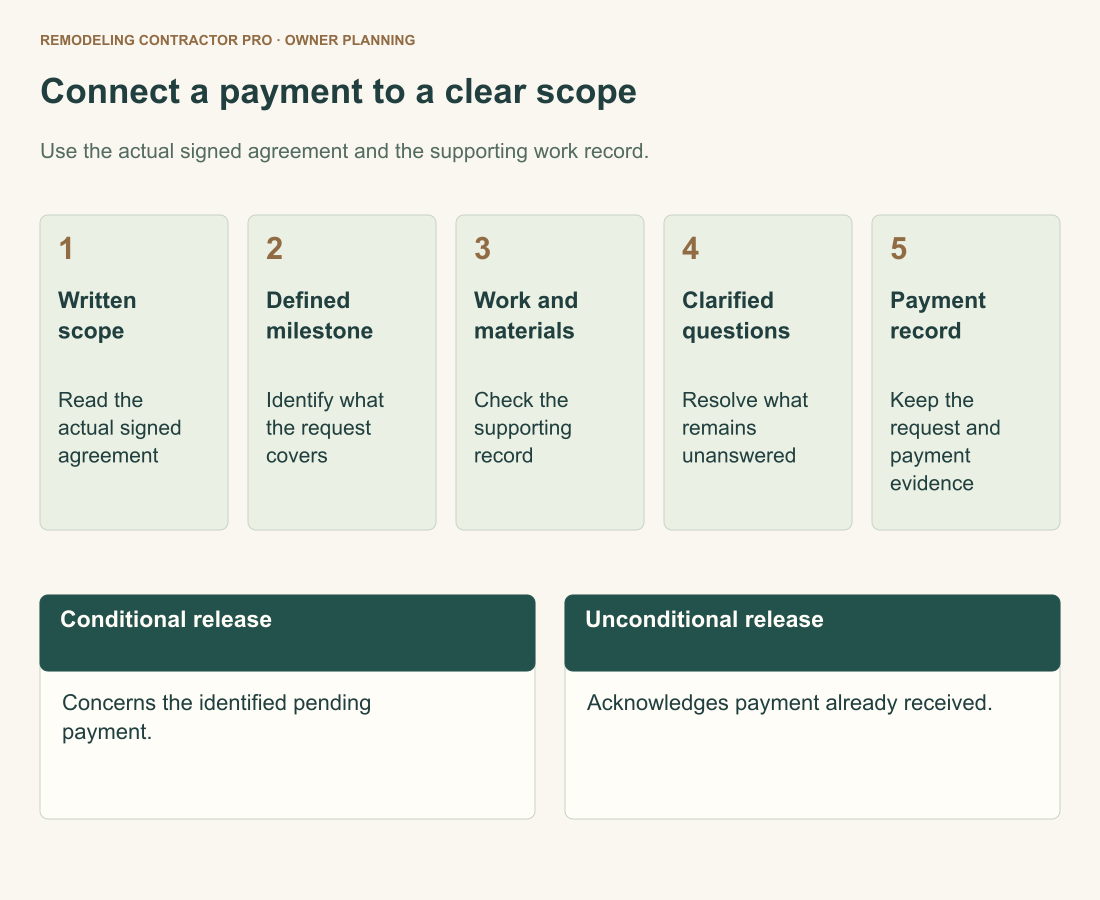
Paying the prime contractor does not by itself establish that subcontractors and suppliers have been paid. CSLB’s lien waiver and release guidance explains the distinction and provides conditional and unconditional forms for progress and final payments.
A conditional release addresses a pending payment. An unconditional release represents an amount already paid. Do not require someone to acknowledge receipt of money they have not received. Current unpaid requests and previously paid portions should therefore be reviewed separately, with the appropriate forms and any exceptions understood.
For prior paid work, the home-improvement provisions address obtaining unconditional releases on request before further payments. That is different from asking for an unconditional release in advance of the current unpaid bill. If an actual dispute or incomplete release arises, get advice on the agreement and facts before deciding how to respond.
Keep preliminary notices, invoices, payment records and releases as different document types. A preliminary notice is not itself a recorded mechanics lien. It can identify a participant whose role should be understood, rather than simply being discarded because the owner deals mainly with the general contractor.
Match documents to the proper claimant, project, amount and period. A release from one supplier does not answer a question about another participant. A document with an exception or a through-date different from the request needs careful reading. The existence of a signed page is not the same as knowing what it covers.

A practical payment folder can keep the current request, supporting scope reference, relevant delivery or completion records, prior payment evidence and releases together. This is an organizational suggestion, not a replacement for the statutory forms or legal review. Avoid editing release language or making a legal template from this article.
Agree on review before a payment is due
Set a practical route for questions before construction begins. Identify who receives requests, who checks them against the agreement and how missing information is raised. If a lender or other reviewer is involved, understand that process alongside the contractor’s schedule. A lender’s willingness to release a draw does not itself settle every contract or statutory question.
Ask for requests in enough time for the agreed review. The appropriate timing depends on the agreement and project; there is no universal review period supplied here. Discuss how weekends, travel or an absent decision maker will be handled without inventing a right to delay a valid payment.
When something is unclear, describe the specific mismatch. “Please identify the delivered items included in this request and the prior amount credited” is more useful than saying the bill feels high. Attach the relevant scope reference so both parties can address the same question.
Keep a distinction between a request for clarification and a payment dispute. If the disagreement concerns contractual rights, alleged defective work or withholding, obtain qualified advice rather than improvising a remedy. This article does not direct owners to stop paying, backcharge a contractor or refuse an otherwise valid obligation.
Write down the response and the next action. Perhaps the contractor will provide a delivery record, the designer will clarify a scope boundary or the owner will confirm a selection. Specific ownership prevents an open question from being mistaken for a resolved decision when the next invoice arrives.
Improve a fictional milestone without pretending it is a contract template
Consider a hypothetical renovation request labeled “Phase two: 30%.” The number gives no explanation of what phase two means. It does not show which rooms, trade work, deliveries or approved changes are included. Even if the percentage matches the schedule, the owner cannot connect it to a clear review.
A more useful description might identify the exact scope section, the work claimed complete in a named area and the specified materials claimed delivered. The parties would then agree what supporting documents are relevant and how previous payments and changes are reflected. This improves readability; it does not establish that any proposed amount is earned or legally compliant.
| Vague element | Clarification needed | Useful supporting reference |
|---|---|---|
| Phase two | Named work and area | Agreement scope and drawing revision |
| Materials | Which specified items and delivery location | Itemized delivery evidence |
| 30% | Dollar amount and value represented | Payment schedule and prior requests |
| Extras | Approved scope and price adjustments | Signed change records |
| Releases | Current unpaid versus previously paid amounts | Appropriate conditional or unconditional documents |
Now imagine the same request includes an appliance the owner bought directly. The review should identify that mismatch without assuming misconduct: perhaps the schedule was not updated or the line includes installation only. A precise question can separate the product, installation and credit instead of treating a broad category as self-explanatory.
If part of the request concerns stored materials, identify that separately too. The parties may need additional contract, delivery or insurance review. The purpose of the example is to make missing information visible before the owner treats a percentage as proof of completed value.
Reconcile the request with a running balance
The following numbers are hypothetical bookkeeping illustrations, not a recommended contract price, schedule or valuation of completed work. Suppose an original agreement is $80,000. One approved change adds $4,500 and another approved change credits $1,200. The current contract amount is therefore $83,300: $80,000 plus $4,500 minus $1,200.
If payments already made total $25,000 and the current request is $12,000, paying that request would bring total payments to $37,000. The remaining contract balance would be $46,300: $83,300 minus $37,000. That arithmetic says nothing by itself about whether the $12,000 has been earned, whether materials were delivered or whether documents are complete.
| Item | Amount | Meaning |
|---|---|---|
| Original agreement | $80,000 | Starting scope amount |
| Approved addition | +$4,500 | Written added scope |
| Approved credit | −$1,200 | Written reduction |
| Current agreement | $83,300 | Original plus approved adjustments |
| Prior payments | $25,000 | Already paid, excluding current request |
| Current request | $12,000 | Still subject to its own review |
| Balance after current payment | $46,300 | Remaining contract amount if request is paid |
Now suppose an additional selection change has been discussed but not agreed. Keep it outside the approved-change total and identify it as unresolved. Mixing it into the balance would make an apparently precise number depend on an open decision. Once the parties resolve it in the appropriate written form, the current agreement and affected requests can be updated consistently.
Check the basis of the prior-payment total. Does it include the original downpayment? Does it include a direct owner purchase that should be tracked elsewhere? Is a recently issued payment recorded as paid or still pending? These distinctions prevent a reconciliation from appearing correct only because different documents use different definitions.
When an invoice and an owner’s record disagree, compare transaction by transaction before debating the final total. Identify dates, amounts, credits and references. A duplicated entry or omitted credit is a different problem from disagreement about completed work, and it is easier to address when the two questions remain visible.
Use consistent names for the totals. “Balance” might mean the remaining contract amount, the current unpaid invoice or an amount after a proposed change. Put the meaning beside the number. In this illustration, the $46,300 is the contract balance after the current payment, not a valuation of work left to build or money currently due. That distinction prevents an otherwise correct total from answering the wrong question.
Reconciliation also provides a clear place to identify a credit awaiting documentation or a request awaiting evidence. Keep each open item attached to its scope and response rather than hiding it in a miscellaneous adjustment.
Define closeout while the agreement is still being discussed
Closeout should not become an improvised collection of demands at the final invoice. Identify the deliverables that belong to the agreed scope and who supplies them. Depending on the work and agreement, the discussion may include permit records, product information, operating instructions, agreed correction items and payment documentation. Confirm actual requirements rather than assuming every project has the same package.
Distinguish completion of work from delivery of information. A fixture can be installed while its operating instructions remain unprovided. A payment record can be complete while an agreed correction remains unresolved. Listing the separate items helps the parties understand what each question concerns without treating all closeout as one undefined condition.
Walk through the agreed scope using a written list of observations. Describe a location and issue clearly enough for the contractor to respond. “Cabinet door beside the refrigerator rubs when opened” identifies a condition; “kitchen unfinished” leaves the extent unclear. Keep new requests separate from corrections to contracted work.
For systems the owner will operate, arrange a practical explanation of controls and maintenance information included in the agreement. Identify where documents will be delivered and who receives them. If someone else will manage the property, include that person in the handover planning rather than assuming they will reconstruct the operation later.
Then reconcile the final financial position using the same definitions as earlier requests. Include approved credits and changes, distinguish current pending releases from prior paid-work releases and identify any disputed item separately. If a disagreement affects payment rights or obligations, use qualified advice on the actual contract. A tidy spreadsheet alone cannot decide the legal result.
A clear closeout discussion benefits the payment schedule from the beginning. It gives the final milestone a defined subject and gives the owner a way to prepare for ongoing use of the completed work. The goal is an agreement the parties can read and administer, with questions raised specifically and resolved through the appropriate process.
Use a payment review record that supports a conversation
The Construction payment-schedule review record has 20 editable notes fields for the agreement type, scope, deposit basis, milestone, evidence, prior payments, changes, notices, due date and next action. It creates a notes summary, clears entries and supports browser printing. It does not autosave, submit a request, calculate a balance or provide a legal compliance score.
Use one review record for the particular question or payment under discussion. Include the document reference and who will answer each unresolved point. Keep financial account details and sensitive personal information out of a planning worksheet when they are unnecessary to explain the issue.
Before leaving the worksheet, use browser printing if you want to retain the notes. The useful output is an organized conversation record, not a certificate that a contract or payment is lawful. Actual contract questions should be resolved against the signed agreement and applicable law.

Resolve the agreement questions before work begins
Is a large deposit justified by custom materials?
Custom procurement alone does not establish an exception to the normal home-improvement downpayment rule. Confirm the agreement scope and any claimed qualifying arrangement with CSLB rather than relying on a supplier’s payment terms.
Does the final invoice settle closeout?
Compare it with the agreement’s completion and closeout provisions, approved changes and payment history. Identify the specific deliverables and questions still open. Do not assume an invoice replaces required documents or that every newly requested item was part of the contract.
What belongs in the proposal discussion?
Bring the intended scope, available plans, selection assumptions and questions about payment milestones. For addition planning, the home addition budget guide helps organize the broader project categories that the agreement must address.
Discuss your construction scope with Remodeling Contractor Pro. Share the property address, proposed work, available plans and budget to prepare for a clear project and proposal conversation.
REMODELING CONTRACTOR PRO · OWNER PLANNING
Construction payment-schedule review record
Use this worksheet to record the actual property, proposed work and questions you need to resolve. Keep the source of an answer, who is responsible and the next action beside your notes. Leave an unknown item visibly unresolved.
Create a separate saved copy for each option, concept or service you are comparing. This tool does not submit your entries or save them automatically. Use View entered notes to select and copy a summary, or Print / save as PDF through your browser before closing or reloading. It does not calculate costs or determine approvals.
Your entered notes