Remodel contract planning · California homeowners
Fixed Price and Cost Plus Remodeling Quotes: California Contract Checks
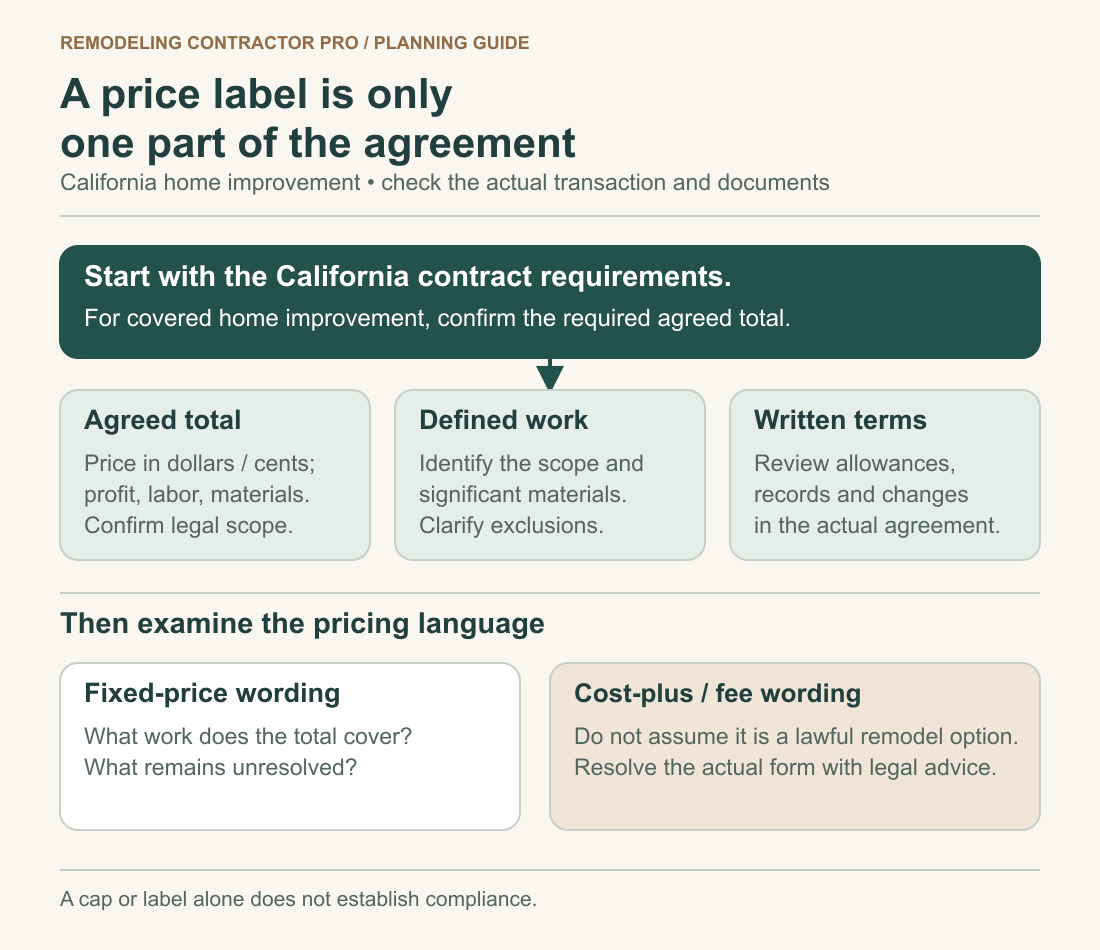
For a substantial California home improvement project, begin with the written contract requirements and agreed total price. A proposal labeled “cost plus,” “fixed price” or “guaranteed maximum” does not establish compliance. Compare the defined work, price wording, allowances, exclusions and records, and have unresolved legal terms reviewed before signing.
Explore this guide
Start with California’s written total-price requirements
A pricing comparison can become misleading when it begins as a menu of equally available contract labels. California’s covered home improvement contracts have specific written price requirements. Your first question should be whether the actual agreement satisfies those requirements for the proposed work, before deciding whether its economic description sounds appealing.
Business and Professions Code section 7159 requires a contract price stated in dollars and cents for covered home improvement contracts. Section 7159.5 requires the written agreement to state the agreed amount, including profit, labor and materials, with finance charges separately stated. Read the provisions in the 2026 CSLB law book. A total labeled merely as an estimate is not the same document concept as an agreed contract price.
CSLB’s Disaster Help Center expressly requires fixed-price contracts for disaster-related rebuilding. It also advises homeowners contracting for other home improvement work to ensure a fixed-price contract and agree to a total. That current consumer guidance belongs at the start of a remodeling discussion, rather than after an unrestricted recommendation to choose cost plus.
This guide concerns proposal review for substantial residential remodeling. It does not decide the legal category of an individual agreement or announce a ban on every construction arrangement in California. If a contractor asserts that your transaction follows a different category or exception, ask for the specific basis and obtain review from a qualified California construction attorney before relying on it.
Separate the estimate, proposal and agreement
Begin by naming the document in front of you. An early budget may help decide whether to develop a scope. A proposal may describe work and assumptions. An executed agreement creates commitments under its actual terms. Similar headings or the same project name do not make those documents interchangeable.
Record the legal entity named, document title, version, attachments and status. Ask which documents would become part of the contract and which remain explanatory background. If a proposal references a drawing set, identify the specific revision. If the scope relies on a finish schedule that has not been created, keep that dependency visible.
Then locate the stated total and read the nearby qualifications. Does the document call it agreed, estimated, preliminary or subject to later calculation? Does another paragraph allow costs to accumulate without a settled amount? Highlight the inconsistency as a question. Do not resolve contradictory wording by selecting whichever sentence sounds most reassuring.
A useful request is: “Please identify the document that would be signed, the agreed total for its defined scope and the attachments establishing that scope. Please clarify how the price language meets the California home improvement requirements applicable to this work.” This is suggested question wording, not contract language or a legal opinion about the answer.

Understand the labels without mistaking them for permission
In general construction discussion, a lump-sum or fixed-price label describes an agreed amount for defined work. A cost-plus label describes a cost basis combined with a fee. Unit-price and guaranteed-maximum descriptions introduce other economic ideas. The CSLB law book discusses several structures in its general business material, but that discussion does not authorize open-ended cost-plus contracting for a covered California home improvement project. See the law book’s contract discussion and home improvement provisions.
The labels can still help you recognize questions in a proposal. If a document uses “cost,” ask which costs it means. If it uses “fee,” ask what the fee covers. If it says “fixed,” ask exactly which scope is fixed. If it says “maximum,” ask what can move outside that maximum. Those questions are useful even when the final agreement must state a compliant agreed total.
Transparency is also different from price structure. A contractor may explain the basis of a fixed quote or share supporting information without converting the agreement into reimbursement of every actual cost. Conversely, a long spreadsheet does not make an unresolved total satisfactory. Keep the calculation explanation and the contractual commitment separate.
A cap or a guaranteed-maximum label should receive the same scrutiny. Do not assume that adding a ceiling to open-ended wording cures every legal problem. Ask counsel to review the actual category, scope, price and exceptions. An economic label can describe an idea; only review of the real agreement can address its legal fit.
Read the scope before judging the total
A fixed total is meaningful only in relation to the work it includes. Compare the room list, drawings, specifications, significant materials and stated boundaries. California’s home improvement requirements address the work description and significant materials as well as price. CSLB’s consumer guide to home improvement contracts explains the importance of a specific written agreement.
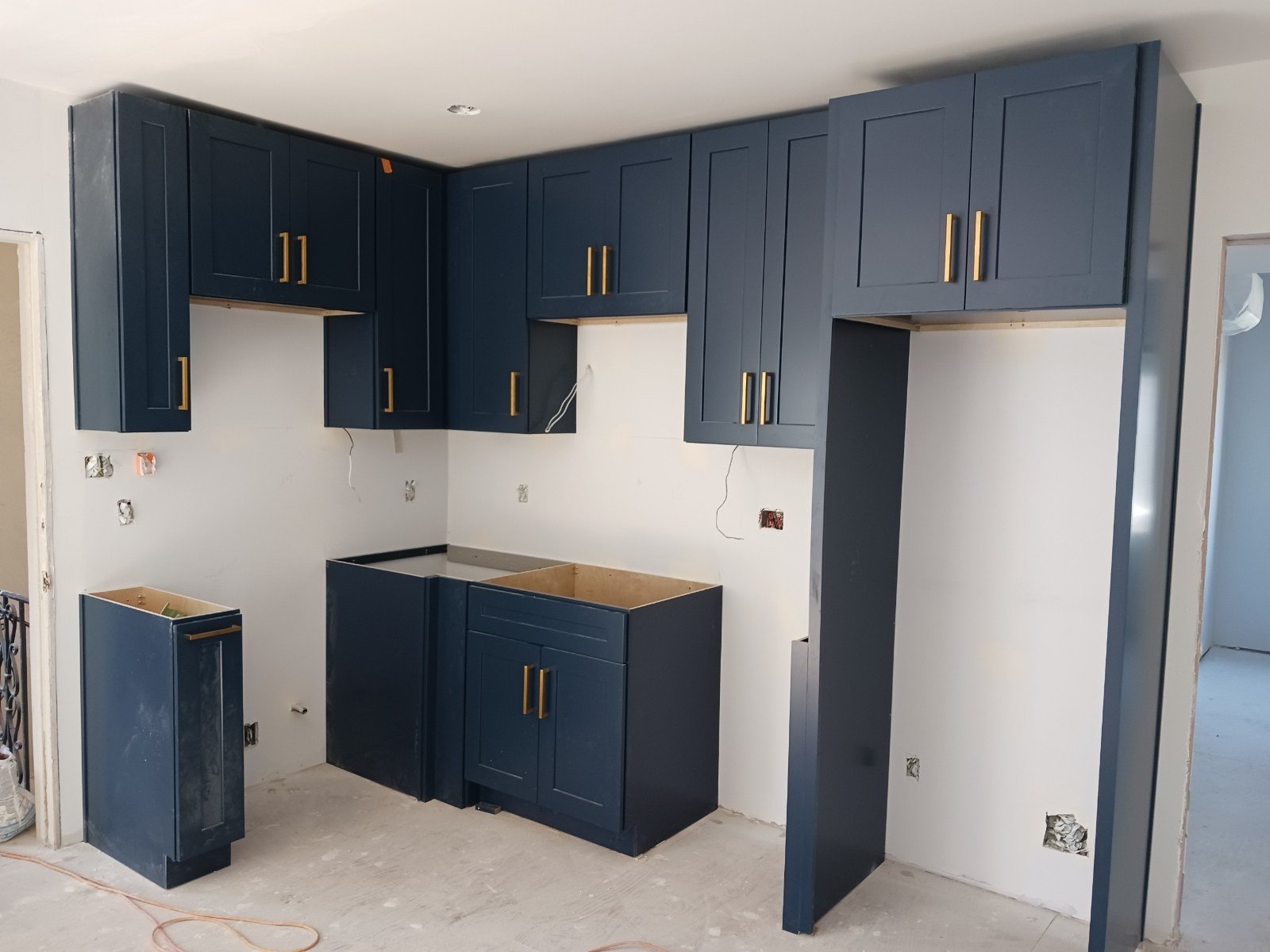
Replace broad project names with identifiable work. For example, a hypothetical bathroom scope might distinguish retained layout, shower assembly, fixtures, electrical work, ventilation and restoration outside the room. The point is not to write the contractor’s technical specification yourself. It is to see whether the price and the described work refer to the same project.
Pay attention to references such as “per plans,” “standard fixtures” or “finish repair included.” Ask which plans, which fixture schedule and which repair areas those phrases identify. A fixed figure attached to undefined references leaves the homeowner unable to tell what the contractor has undertaken.
For the earlier decisions that develop a coherent renovation scope, see Planning a Whole-Home Renovation in Los Angeles: What to Decide Before Demolition. Bring the selected scope into the contract discussion once it is developed. Do not expect a pricing label to resolve design choices that have not yet been made.
Compare a hypothetical set of quote descriptions
Imagine a hypothetical owner reviewing descriptions for the same proposed remodel. The intended work includes selected fixtures, concealed-condition investigation, installation, delivery coordination and finish restoration. No prices or fee percentages are supplied. This is a document-reading exercise, not a comparison of lawful contract options or a template to sign.
| Review item | Description A: stated total | Description B: cost-and-fee wording | Question before commitment |
|---|---|---|---|
| Price commitment | Shows a stated amount linked to referenced scope documents. | Shows an estimate and says actual costs plus a fee determine the eventual amount. | Where is the compliant agreed total for covered home improvement work? |
| Selections | Some products are identified; another category is called an allowance. | Products are expected to be reimbursed but coverage is unclear. | Which selections and associated work are actually included? |
| Unknown conditions | Contains an exclusion for an uninvestigated condition. | Appears to let additional costs accumulate. | What investigation, defined scope and written revision are needed? |
| Fee basis | The total may incorporate profit without a separate percentage. | Fee wording does not identify all included cost categories. | Which items make up the cost base and fee, and could they overlap? |
| Records | Supporting information may be supplied as agreed. | Mentions receipts without defining access or reconciliation. | What records are promised, and what do they establish? |
| Ceiling | No assumption that the scope cannot change. | Mentions a cap with exceptions. | What does the cap cover, and does the actual agreement satisfy applicable law? |
Description A still needs review for scope, exclusions and the full contract requirements. Description B raises an immediate total-price compliance question for covered California home improvement work. The useful conclusion is to request a clear, reviewed agreement, not to select B because it seems more flexible or A because its headline is simpler.
Keep the same intended work on both sides of the exercise. If one description omits restoration or assigns purchases to the owner, identify that difference before discussing its number. This is a check of the mechanism and documents; it does not establish which contractor is qualified or provide a complete competing-bid analysis.
Unpack every allowance
An allowance is easy to misunderstand when the owner treats it as a complete installed item and the proposal uses it for only part of the purchase. Ask what the term means in this document. Identify the product category, selection assumptions, associated work, delivery and any other included or excluded elements.
For a hypothetical vanity allowance, separate the cabinet, top, basin, faucet and installation questions. The selection can affect connections and surrounding finishes. Do not assume the allowance covers all of those consequences merely because they belong to the same visible fixture. Ask the contractor to describe the boundary in the scope and explain how the agreed price accounts for it.
Also ask how a selection different from the stated assumption would be documented. Keep that question tied to the requirement for a compliant agreement and authorized revisions. An allowance should not become an explanation for why the owner cannot identify the contract price or determine what is included.
Record which choices remain open and which are fixed. If a product has already been selected, attach the identifying information and confirm whether it replaces the earlier allowance description. A lingering allowance alongside a fixed selection can leave two different assumptions in the document set. Have the contractor reconcile them before relying on either.
Ask what the cost records will actually show
When a proposal discusses reimbursable costs or records, request a description of the categories and evidence. A receipt can show a purchase, but the owner still needs to understand which project it serves and how the document relates to the agreed work. A stack of invoices is not automatically a clear accounting.
Possible questions include how labor is described, how supplier charges are assigned, what a subcontractor invoice covers and how returns or credits appear. Ask whether records are itemized by scope area and how duplications are resolved. These are document-review questions, not a claim that every contractor must provide the same open-book system.
Keep records access distinct from authority to incur costs. The owner should not assume that seeing a receipt means the related work was properly authorized, included in the agreement or priced consistently with its terms. Likewise, a contractor’s explanation of estimating assumptions does not itself create an open-ended reimbursement agreement.
If a proposed arrangement needs substantial record review, consider who will perform it and what information that person requires. Bring the actual documents to a qualified adviser where appropriate. The workload and clarity of the records are practical matters for the homeowner, but they do not override California’s contract requirements.
Clarify the fee basis and potential overlap
A fee cannot be evaluated from its label alone. Ask what services it covers and which costs sit beneath it. The same word may be used in a proposal for management, overhead, profit or a combination. Do not assume a fee is comprehensive when another line also charges for activities the owner thought it included.
Use a nonmonetary category list. Identify labor, materials, subcontract work, delivery, equipment, supervision and administration as applicable to the proposal. Ask which categories are included in the stated total and which are used in any calculation explanation. The contractor should resolve unclear overlap rather than leave the owner to infer it.
A conceptual formula can help identify a missing definition: described cost base plus described fee equals a calculated amount. It is only a vocabulary aid. Without defined categories it cannot be checked, and it is not an executable contract or a substitute for the required agreed total in covered California home improvement work.
Do not compare a fee percentage from marketing material with an unexplained fee in your own proposal. The underlying scope, cost base and commitments may differ. This guide supplies no market fee rate or recommended percentage. The useful task is to understand the actual document and obtain an agreement that satisfies the applicable requirements.
Separate exclusions from unknown work
An exclusion identifies work outside a defined scope. An unknown identifies something not yet established. The same condition can involve both, but those concepts should not be left blended into a catch-all sentence. Ask what is known, what investigation is proposed and what work the contractor has actually undertaken.
Consider a hypothetical wall condition that has not been assessed. A proposal might exclude repairs beyond a described finish scope, while another document assumes all underlying preparation is included. Highlight the inconsistency. Ask what information is needed to define the work and how the document will be revised once that information is available.
Agreeing on a fixed total does not mean concealed conditions cease to exist or that the owner has purchased every imaginable future change. It makes the definition of scope and revision process more important. Covered home improvement requirements include written change orders signed before the covered changed work. See Business and Professions Code section 7159.
Keep the detailed administration of changes as a separate project task. For this pricing review, identify what could change the described work and ensure the proposed agreement does not rely on an undefined stream of accumulating costs. A clear unanswered investigation is preferable to a number that looks settled only because its assumptions are hidden.

Treat caps and claimed exceptions as review questions
A ceiling can sound reassuring while its exceptions carry the unresolved work. Read what sits inside and outside it, what documents define its scope and who decides when an exception applies. Ask the contractor to reconcile that language with the written agreed-total requirements for the actual home improvement agreement.
Be precise about a payment bond or joint-control explanation. Section 7159.5’s exception for those arrangements addresses specified payment provisions; it does not exempt the agreed-total requirement in paragraph (a)(1). Have counsel review an asserted exception rather than extending it beyond the paragraphs the statute names. See the text of section 7159.5.
Separate small, specially defined service-and-repair provisions from the substantial remodeling scope discussed here. Their existence is not a general workaround for a renovation contract. Do not divide or relabel a project to avoid the applicable requirements. If someone cites a different contracting category, ask an appropriately qualified attorney whether the facts actually fit it.
The purpose of these questions is to prevent a persuasive label from ending the inquiry too soon. A well-explained cap may still need legal review; a fixed-price heading may still contain inconsistent terms. Evaluate the document as a whole, and resolve material questions before signing rather than relying on an informal verbal interpretation.
Keep price determination separate from payment timing
The contract price answers a different question from the payment schedule. One establishes the amount agreed for the described scope; the other addresses payment events under its applicable rules. A detailed schedule cannot cure an undefined price, and a stated total does not make every proposed payment request appropriate.
For the separate payment review, see California Contractor Payment Schedules: What to Check. Keep the same scope version attached to both discussions so the project is not reviewed under different assumptions. This article does not reproduce the payment rules or replace a full contract review.
Likewise, do not treat a requested deposit as proof that the price has been settled. If the owner cannot identify the agreement, its scope and its agreed amount, return to those documents. Commercial urgency does not supply missing definitions, and an early budget does not become a compliant contract simply because a payment date is proposed.
Write down the question that prevents commitment and assign the next action. The contractor may need to issue a clarified document, the owner may need to approve a selection, or an attorney may need to address a legal inconsistency. A short record of that dependency is more useful than continuing to compare headlines while the same ambiguity remains.
Create a focused document-request sheet
Ask for the proposed agreement and every incorporated scope document, with current revisions identified. Request clarification of the stated total, allowance boundaries, exclusions, owner commitments, fee wording, supporting-record promises and claimed cap or exception. Keep each request connected to the paragraph that prompted it.
For each response, record whether the document changed. A helpful explanation in an email can identify the issue, but ask how the agreed understanding is reflected in the actual proposed agreement. Do not assume a verbal reassurance controls contradictory written terms. The legal significance of conflicting documents belongs with the qualified adviser reviewing them.
Then compare the revised agreement to the original question list. Has the total-price issue been resolved? Do the references identify the intended work? Are the allowances and exclusions understandable? Has a claimed exception received appropriate review? Mark unanswered items as open rather than accepting a new version solely because its filename says final.
A completed pricing clarification record is not an attorney’s certification. It helps the homeowner arrive at professional review with organized questions and makes the contractor’s proposed commitments easier to discuss. Use it alongside the broader qualification, scope and agreement work needed for a substantial project.
Trace one hypothetical selection through the documents
Take a hypothetical basin selection that appears in three places: an early budget, a fixture allowance and a later product schedule. The owner believes the selected basin is included, while the proposal still refers to an undecided allowance. Begin by identifying which schedule the proposed agreement incorporates. This small test can expose a document conflict that the overall total does not reveal.
Next ask whether the selection changes the associated work. A different basin may require a different cabinet or connection arrangement, but the homeowner should not infer the technical consequence. Ask the qualified project team to identify any changed scope. Then ask the contractor to reconcile the product and work descriptions in the agreement. Product price and installation scope are related questions, not interchangeable ones.
Follow the purchase responsibility as well. Who orders, receives and checks the item? What does the proposal say about an incorrect shipment or a return? If the owner purchases it, which related contractor tasks remain included? These questions help define the actual commitment without assuming that an owner purchase removes all handling or coordination from the project.
Finally, trace a credit if the documents contemplate one. Ask where it appears and which earlier assumption it replaces. Keep the supporting record connected to the correct selection and scope version. Do not assume a receipt or supplier credit alone establishes how the contract price changes. Have the actual agreement and any required revision reflect the parties’ resolved commitment.
Turn ambiguous sentences into answerable requests
Suppose a hypothetical proposal says, “Materials billed at cost.” Ask which materials, which cost components, how they relate to the stated total and what supporting information is promised. For covered California home improvement work, also ask how the wording is reconciled with the required agreed contract amount. The sentence creates several questions; it does not answer them by using a familiar phrase.
Suppose another paragraph says, “All necessary work included,” followed by a broad exclusion list. Ask the contractor to identify the included work and explain the boundary between the general sentence and each relevant exclusion. A useful response resolves the particular scope conflict. Replacing one broad reassurance with another leaves the owner in the same position.
For each request, use four parts: the paragraph or attachment, the unclear term, its practical effect and the clarification requested. For example: “The fixture schedule lists the selected basin, while the allowance page leaves it open. Please identify the controlling selection and revise the price and scope references consistently.” This keeps the conversation focused without drafting a legal clause for the contractor.
After clarification, check neighboring references. Revising one allowance page may leave an older assumption in a summary, attachment or email relied upon by the proposal. Ask which documents are superseded and retain the current review set. Consistent documents make professional review easier; they do not by themselves certify compliance or predict how a dispute would be decided.
If a material inconsistency remains, identify it as the reason the pricing review is incomplete. The next step might be a contractor revision or attorney review, depending on the issue. Avoid treating the absence of a numerical dispute as agreement: the parties can accept the same headline amount while understanding its scope and possible additions very differently.
Use the remodel contract pricing clarification record
The Remodel contract pricing clarification record has 20 editable fields for the work, legal entity, document version, price basis, scope references, fixed-price wording, cost-plus wording, allowances, exclusions, unknown work, records, fee basis, caps, changes, separate payment review, current sources, legal questions, responses, unresolved terms and retained documents.
It can create a notes summary, clear entries and use browser printing. It does not autosave, calculate a lawful contract structure or submit information. Retain the notes you need before leaving or resetting it. Use it to support a document discussion, with qualified California legal review of material contract questions.
For a scope-specific remodeling discussion, contact Remodeling Contractor Pro with the property address, intended work and the scope decisions still unresolved. Confirm service availability and discuss the actual proposed agreement rather than assuming any pricing structure is offered.
REMODELING CONTRACTOR PRO · OWNER PLANNING
Remodel contract pricing clarification record
Record the actual property, proposed work and the decisions you need to resolve. Keep the source of an answer, the responsible person and the next action beside your notes. Leave an unknown item visibly unresolved.
This worksheet does not submit or save entries automatically. Use View entered notes to select and copy a summary, or Print / save as PDF through your browser before closing or reloading. It does not calculate costs, design construction or determine approvals. Keep a separate saved copy for each option you compare.
Your entered notes